Everything Has Its Time

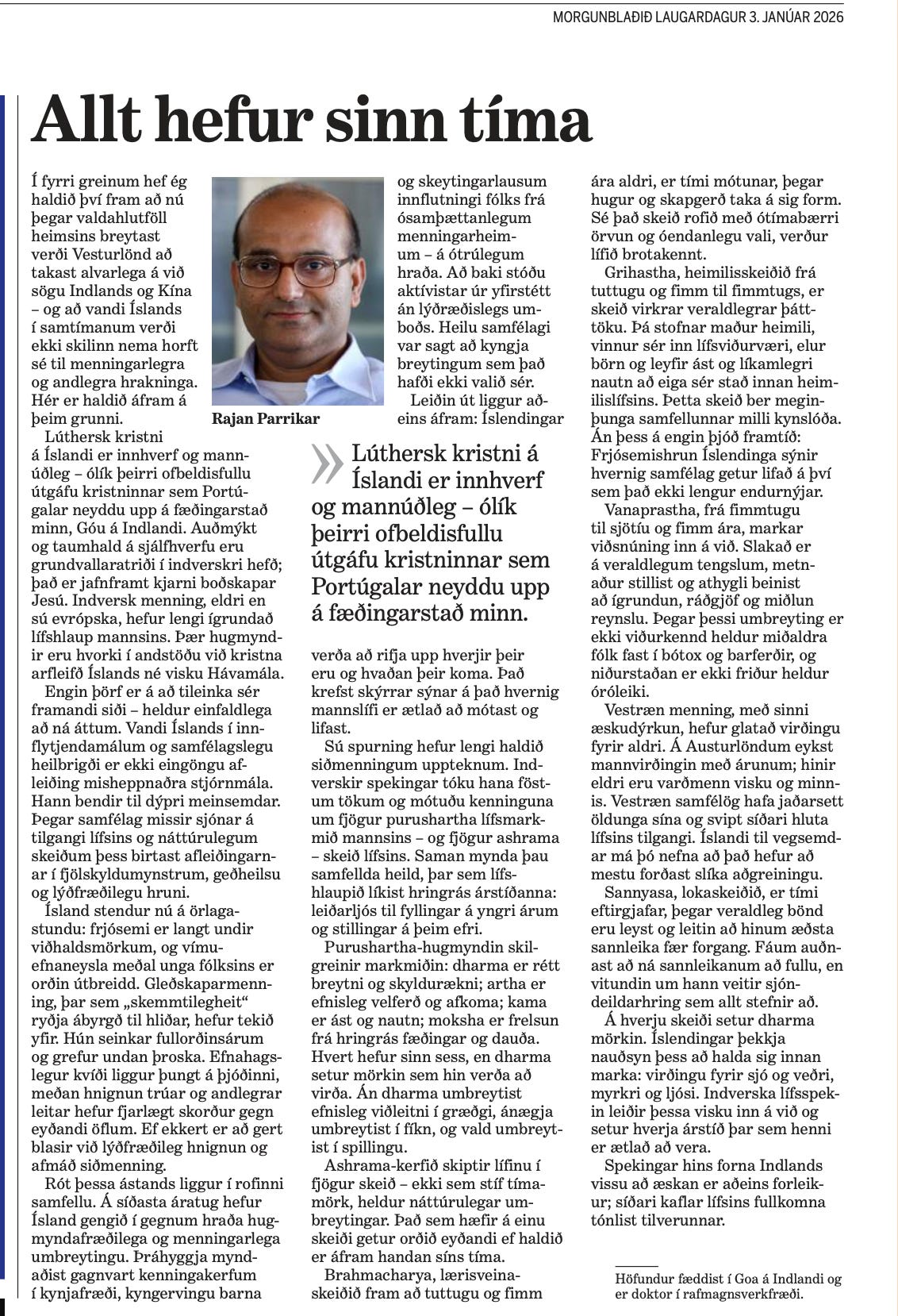
[This column was published in Icelandic on January 03, 2026 in Morgunblaðið. See screenshot below.]
In earlier columns, I argued that as global power rebalances, the West must seriously engage the history of India and China, and that Iceland’s present malaise cannot be understood without addressing cultural and spiritual dislocations. This column builds on those observations.
Iceland’s Lutheranism is inward and humane, unlike the violent Christianity the Portuguese imposed on my birthplace, Goa. Humility and the curbing of ego are foundational to Indian tradition; they also lie at the heart of Jesus’s teaching. Indian civilisation, older than Europe’s, has long reflected on the passage of life. These ideas do not stand apart from Iceland’s Christian inheritance or the wisdom of Hávamál.
What is at stake is not adoption of foreign forms, but the recovery of direction. Iceland’s crisis of immigration and social health is not merely a political failure. It reflects deeper pathologies at work. When a society loses sight of life’s purpose and its natural stages, the consequences surface in family formation, mental health, and demographic collapse.
Iceland has entered a decisive phase: fertility has fallen far below replacement, and substance abuse among the young is widespread. A party-centric culture, where ‘fun’ displaces responsibility, prevails, deferring adulthood and eroding maturity. Economic anxiety bears down, while the waning of religion and spiritual aspiration has removed restraints on these malign forces. Left unchecked, Iceland risks demographic decline and cultural erasure.
This affliction stems from a rupture in continuity. Over the past decade, Iceland underwent rapid ideological and cultural transformation. Fixations on gender ideology, sexualisation of children, and reckless immigration from incompatible cultures were introduced with remarkable speed. These were driven by an activist elite with no popular sanction. An entire society was asked to absorb change it had not chosen.
The only way out now is through: Icelanders must recall who they are and where they come from. It will require a clear conception of how a human life is meant to be shaped and lived.
The question has preoccupied civilisations. Hindu thinkers addressed this rigorously, advancing the four purusharthas, the aims of life, and the four ashramas, the stages of life. Together they form an integrated framework that treats the life span as the turning of seasons, guiding us toward fullness in youth and composure in age.
The purusharthas define the aims. Dharma is right conduct and duty. Artha is material well-being. Kama is love and pleasure. Moksha is liberation from the cycle of birth and death. Each has its place, but dharma sets the boundaries within which the others find their expression. Without it, material pursuit hardens into greed, pleasure into addiction, and power into corruption.
The ashramas divide life into four stages, not as rigid thresholds but as natural transitions. What is fitting in one season becomes destructive when carried beyond its time.
Brahmacharya, the student stage up to twenty-five, is the period of formation, when mind and character take shape. When this stage is invaded by premature stimulation and excess choice, it gives way to fragmentation.
Grihastha, the householder stage from twenty-five to fifty, is the period of active worldly life. One forms a household, pursues livelihood, raises children, and gives place to love and physical pleasure within domestic life. This stage bears the central burden of continuity. Without it, no nation has a future: Iceland’s fertility collapse shows how a society consumes what it can no longer renew.
Vanaprastha, from fifty to seventy-five, marks the turning inward. Worldly ties are loosened, ambition tempered, and attention shifts to reflection, counsel, and transmission. Where no such transition is recognised, middle age clings anxiously to Botox and bars, yielding not peace but agitation.
Western culture, with its cult of youth, no longer accords authority to age. In the East, growing older enlarges a person’s standing; elders are custodians of memory and wisdom. Western societies marginalise the old and strip later life of purpose. To its credit, Iceland avoids such segregation.
Sannyasa, the final stage, is the renunciate phase, when worldly ties are surrendered and the search for ultimate truth takes precedence. Few may reach it fully, but its presence provides a horizon for all that precedes it.
At every stage, dharma is the boundary condition. Icelanders know the necessity of limits: respect for sea and weather, for darkness and light. The Hindu architecture of life extends this wisdom inward, placing each season where it belongs.
The seers of ancient India understood that youth is only a prelude. It is the later movements that complete the music of existence.
- RP, Jan 2026.
Morgunblaðið, January 03, 2026.